
Huawei P30 Pro vs S10+, iPhone XS, Pixel 3, Mi 9 & Mate 20 Pro

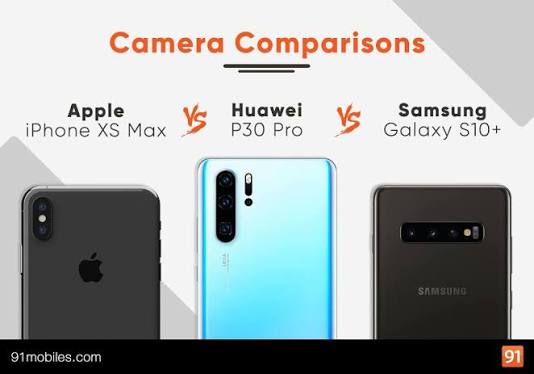
The Huawei P30 Pro was one of Huawei’s most feature-rich smartphones of its generation, particularly known for its camera system, large battery, zoom capabilities, and fast charging. But how does it compare with other flagship smartphones from the same era, including the Samsung Galaxy S10+, iPhone XS, Google Pixel 3, Xiaomi Mi 9, and Huawei Mate 20 Pro?
In this detailed comparison, we look at the major specifications and features of these smartphones, including their displays, processors, cameras, batteries, storage, and overall hardware design.
Note: These are smartphones from different manufacturers and, in some cases, different release periods. Specifications can vary by market and regional model.
Huawei P30 Pro at a Glance
The Huawei P30 Pro combines a 6.47-inch OLED display with Huawei’s Kirin 980 processor, up to 8GB of RAM, and up to 256GB of internal storage. Its rear camera system consists of a 40MP main camera, 20MP ultra-wide camera, 8MP telephoto camera, and a Time-of-Flight depth sensor. Huawei also equipped it with a 4,200mAh typical-capacity battery and SuperCharge technology.
One of the phone’s defining features is its long-range photography system. Huawei used a periscope-style telephoto camera to provide substantially more zoom capability than many conventional dual- or triple-camera smartphones of the period.
Huawei P30 Pro vs Galaxy S10+
The Samsung Galaxy S10+ features a 6.4-inch Dynamic AMOLED display with a 3040 × 1440 resolution. Samsung offered several memory configurations, including versions with 8GB RAM and up to 1TB of internal storage, depending on the model.
Its rear camera setup includes a 12MP wide camera, 16MP ultra-wide camera, and 12MP telephoto camera. The phone also supports 2x optical zoom and 4K video recording at up to 60 frames per second.
The S10+ has a 4,100mAh battery and supports wireless charging. Samsung also included features such as expandable storage through microSD on supported variants.
Key differences
The P30 Pro emphasizes long-range photography and a large battery, while the S10+ combines a high-resolution Dynamic AMOLED display, expandable storage, and Samsung’s broader camera configuration.
Huawei P30 Pro vs iPhone XS
The iPhone XS uses Apple’s A12 Bionic chip and features a 5.8-inch Super Retina OLED display with a 2436 × 1125 resolution. Apple offered the phone in 64GB, 256GB, and 512GB storage capacities.
The iPhone XS has a dual 12MP rear-camera system consisting of wide-angle and telephoto cameras. It supports 2x optical zoom, optical image stabilization, Smart HDR, and 4K video recording.
Compared with the P30 Pro, the iPhone XS is considerably smaller. It also uses Apple’s iOS ecosystem rather than Android and EMUI.
Camera approach
The two phones take different approaches to mobile photography. The P30 Pro uses a multi-camera system with an ultra-wide lens, long-range telephoto lens, and ToF depth sensing. The iPhone XS uses a simpler dual-camera arrangement but combines it with Apple’s computational photography and image-processing technologies.
Huawei P30 Pro vs Google Pixel 3
The Google Pixel 3 has a 5.5-inch flexible OLED display with a 2160 × 1080 resolution and is powered by Qualcomm’s Snapdragon 845 processor with 4GB of RAM. Storage options were 64GB and 128GB.
Interestingly, the Pixel 3 uses a single 12.2MP rear camera rather than the multi-camera systems found on the P30 Pro and many competing flagships.
Google combined that camera hardware with software-based image processing. The Pixel 3 also has dual front cameras, including a wide-angle camera designed for group selfies.
The Pixel 3 has a 2,915mAh battery and supports 18W wired charging and Qi wireless charging.
P30 Pro vs Pixel 3
The P30 Pro offers substantially more camera hardware and a larger battery, while the Pixel 3 represents Google’s software-focused approach to smartphone photography.
Huawei P30 Pro vs Xiaomi Mi 9
The Xiaomi Mi 9 features a 6.39-inch AMOLED display with a 2340 × 1080 resolution and uses Qualcomm’s Snapdragon 855 processor. Xiaomi offered versions with 6GB or 8GB of RAM and 64GB or 128GB of storage.
Its rear cameras consist of a 48MP main camera, 12MP telephoto camera, and 16MP ultra-wide camera. The phone also has a 20MP front-facing camera.
The Mi 9 has a battery capacity of approximately 3,300mAh and uses an in-display fingerprint sensor.
P30 Pro vs Mi 9
The Mi 9’s Snapdragon 855 gives it a different performance profile from the P30 Pro’s Kirin 980. Meanwhile, the P30 Pro has the larger battery and a more advanced long-range camera system.
Huawei P30 Pro vs Mate 20 Pro
The Huawei Mate 20 Pro is perhaps the most natural comparison because it also uses Huawei’s Kirin 980 platform and Leica-branded camera technology.
The Mate 20 Pro features a 6.39-inch OLED display with a 3120 × 1440 resolution. It uses the Kirin 980 processor and was offered with 6GB RAM and 128GB storage in one major configuration, with some markets offering additional configurations.
Its Leica triple-camera system consists of a 40MP wide camera, 20MP ultra-wide camera, and 8MP telephoto camera. It also has a 24MP front camera.
The Mate 20 Pro features a 4,200mAh battery, 40W Huawei SuperCharge, and 15W wireless charging. It also supports IP68-level water and dust resistance.
What’s different?
The P30 Pro builds on the Mate 20 Pro’s camera concept with a redesigned rear-camera system and a periscope telephoto lens. The P30 Pro also offers a 32MP front camera compared with the Mate 20 Pro’s 24MP front camera.
Full Specification Comparison
| Feature | Huawei P30 Pro | Galaxy S10+ | iPhone XS | Pixel 3 | Xiaomi Mi 9 | Mate 20 Pro |
|---|---|---|---|---|---|---|
| Display | 6.47″ OLED | 6.4″ Dynamic AMOLED | 5.8″ OLED | 5.5″ OLED | 6.39″ AMOLED | 6.39″ OLED |
| Resolution | 2340 × 1080 | 3040 × 1440 | 2436 × 1125 | 2160 × 1080 | 2340 × 1080 | 3120 × 1440 |
| Processor | Kirin 980 | Exynos/Snapdragon, market dependent | A12 Bionic | Snapdragon 845 | Snapdragon 855 | Kirin 980 |
| RAM | Up to 8GB | Up to 12GB | Apple does not market RAM configuration | 4GB | 6GB/8GB | 6GB/8GB depending on market |
| Rear cameras | 40MP + 20MP + 8MP + ToF | 12MP + 16MP + 12MP | 12MP + 12MP | 12.2MP | 48MP + 12MP + 16MP | 40MP + 20MP + 8MP |
| Front camera | 32MP | 10MP + 8MP | 7MP | 8MP dual | 20MP | 24MP |
| Battery | 4,200mAh | 4,100mAh | — | 2,915mAh | ~3,300mAh | 4,200mAh |
| Storage | Up to 256GB | Up to 1TB | Up to 512GB | 64/128GB | 64/128GB | 128GB/256GB depending on market |
| Wireless charging | Yes | Yes | Yes | Yes | Yes | Yes |
| Water resistance | IP68 | IP68 | IP68 | IP68 | No full submersion rating | IP68 |
Specifications can vary by regional version, especially processor, RAM, storage, and network configurations.
Camera Comparison
Camera technology was one of the biggest differentiators among these phones.
Huawei P30 Pro
The P30 Pro uses a four-part rear camera system with a 40MP main sensor, 20MP ultra-wide camera, 8MP telephoto camera, and ToF depth sensor. Huawei’s periscope telephoto design was specifically developed for long-distance zoom photography.
Galaxy S10+
Samsung uses a triple rear-camera arrangement with wide, ultra-wide, and telephoto cameras. The S10+ supports 2x optical zoom and 4K recording at up to 60fps.
iPhone XS
The iPhone XS has two 12MP rear cameras and supports 2x optical zoom, optical stabilization, Smart HDR, and 4K video.
Pixel 3
Google took a different approach with a single 12.2MP rear camera supported by computational photography.
Mi 9
The Mi 9 uses a triple-camera system with 48MP main, 12MP telephoto, and 16MP ultra-wide cameras.
Mate 20 Pro
The Mate 20 Pro features a Leica triple-camera system with 40MP wide, 20MP ultra-wide, and 8MP telephoto cameras.
Display and Design
Display preferences can vary considerably between users.
The Galaxy S10+ offers a 6.4-inch Dynamic AMOLED panel with a high 3040 × 1440 resolution, while the Mate 20 Pro has a 6.39-inch OLED panel with 3120 × 1440 resolution.
The P30 Pro has a 6.47-inch OLED display at 2340 × 1080 resolution. Its larger screen makes it suitable for video, browsing, gaming, and other media-focused activities.
The iPhone XS and Pixel 3 are considerably smaller at 5.8 and 5.5 inches respectively.
Performance
The P30 Pro and Mate 20 Pro both use Huawei’s Kirin 980 platform. The P30 Pro combines the processor with up to 8GB RAM.
The Mi 9 uses Qualcomm’s Snapdragon 855, while the Pixel 3 uses the older Snapdragon 845.
The iPhone XS uses Apple’s A12 Bionic chip.
Because these devices use different operating systems, chip architectures, and software optimizations, raw specifications should not be treated as a complete measure of real-world performance.
Battery and Charging
Battery capacity is another major difference.
The P30 Pro and Mate 20 Pro both use 4,200mAh batteries. Huawei’s specifications also list 40W SuperCharge for the Mate 20 Pro, while the P30 Pro supports Huawei SuperCharge and 15W wireless charging.
The Galaxy S10+ has a 4,100mAh battery.
The Pixel 3 has a 2,915mAh battery and supports 18W wired charging and wireless charging.
The Mi 9 has a battery of approximately 3,300mAh.
Battery capacity alone does not determine battery life because display resolution, processor efficiency, software, network conditions, and individual usage all affect actual runtime.
Storage Options
Storage was another area where these phones differed significantly.
The Galaxy S10+ was available in configurations ranging from 128GB to 1TB, with microSD support on supported models.
The iPhone XS was available with 64GB, 256GB, or 512GB.
The Pixel 3 came with 64GB or 128GB of internal storage.
The Mi 9 was offered with 64GB or 128GB, while the P30 Pro was available with up to 256GB depending on configuration and market.
Which Phone Has the Most Interesting Camera Hardware?
The P30 Pro stands out for its combination of multiple focal lengths, ToF depth sensing, and periscope telephoto technology. Huawei specifically promoted its SuperZoom system as a way to achieve substantially greater long-range zoom than conventional smartphone telephoto systems.
The Galaxy S10+, iPhone XS, Pixel 3, Mi 9, and Mate 20 Pro take different approaches to camera hardware and software processing.
For that reason, camera comparison should consider the type of photography you do rather than simply counting megapixels.
Final Thoughts
The Huawei P30 Pro vs S10+, iPhone XS, Pixel 3, Mi 9, and Mate 20 Pro comparison shows how different flagship smartphones approached mobile technology during the same generation.
The P30 Pro combines a large OLED display, Kirin 980 processor, 4,200mAh battery, and an unusually versatile Leica camera system with long-range zoom capabilities.
The Galaxy S10+ emphasizes its high-resolution Dynamic AMOLED display, expandable storage on supported models, and versatile triple-camera system.
The iPhone XS focuses on Apple’s A12 Bionic platform, Super Retina OLED display, and integrated iOS ecosystem.
The Pixel 3 takes a software-oriented photography approach with a single rear camera and Google’s computational imaging technology.
The Mi 9 combines the Snapdragon 855 with a triple-camera system and AMOLED display, while the Mate 20 Pro shares the Kirin 980 platform and 4,200mAh battery class with the P30 Pro.
Ultimately, these phones were designed around different priorities. Looking at camera hardware, display technology, processing platform, battery capacity, storage, and software together gives a more complete picture than focusing on a single specification.
FAQ:
Is the Huawei P30 Pro better than the Galaxy S10+?
The two phones emphasize different features. The P30 Pro has a distinctive long-range camera system and 4,200mAh battery, while the S10+ offers a high-resolution Dynamic AMOLED display, expandable storage on supported models, and a versatile triple-camera setup.
Does the P30 Pro have a better zoom system than the iPhone XS?
The P30 Pro was specifically designed with a periscope telephoto system for extended-range zoom, whereas the iPhone XS provides 2x optical zoom through its telephoto camera.
Which phone has the largest battery?
Among the models compared here, the Huawei P30 Pro and Huawei Mate 20 Pro each have a 4,200mAh typical battery capacity, while the Galaxy S10+ has 4,100mAh.
Does the Galaxy S10+ support expandable storage?
Supported Galaxy S10+ variants provide microSD expansion, with Samsung documentation listing support for cards up to 512GB.
What processor does the Huawei P30 Pro use?
The Huawei P30 Pro uses Huawei’s Kirin 980 octa-core processor with dual NPUs.
Is the Pixel 3 a dual-camera phone?
The Pixel 3 has one 12.2MP rear camera, while its front-facing system includes two 8MP cameras.
How much storage did the iPhone XS offer?
The iPhone XS was available with 64GB, 256GB, and 512GB internal storage options.